Last updated 2026-07-25
TL;DR
A legitimate MOTS-c certificate of analysis (COA) shows third-party HPLC purity, mass spec identity confirmation, sequence match, and a batch or lot number tied to the vial you actually received. No COA verifies safety or a specific dose works in humans, since MOTS-c has no FDA-approved use and almost all efficacy data is rodent or cell-culture work, not clinical trials.
What is a MOTS-c certificate of analysis, actually?
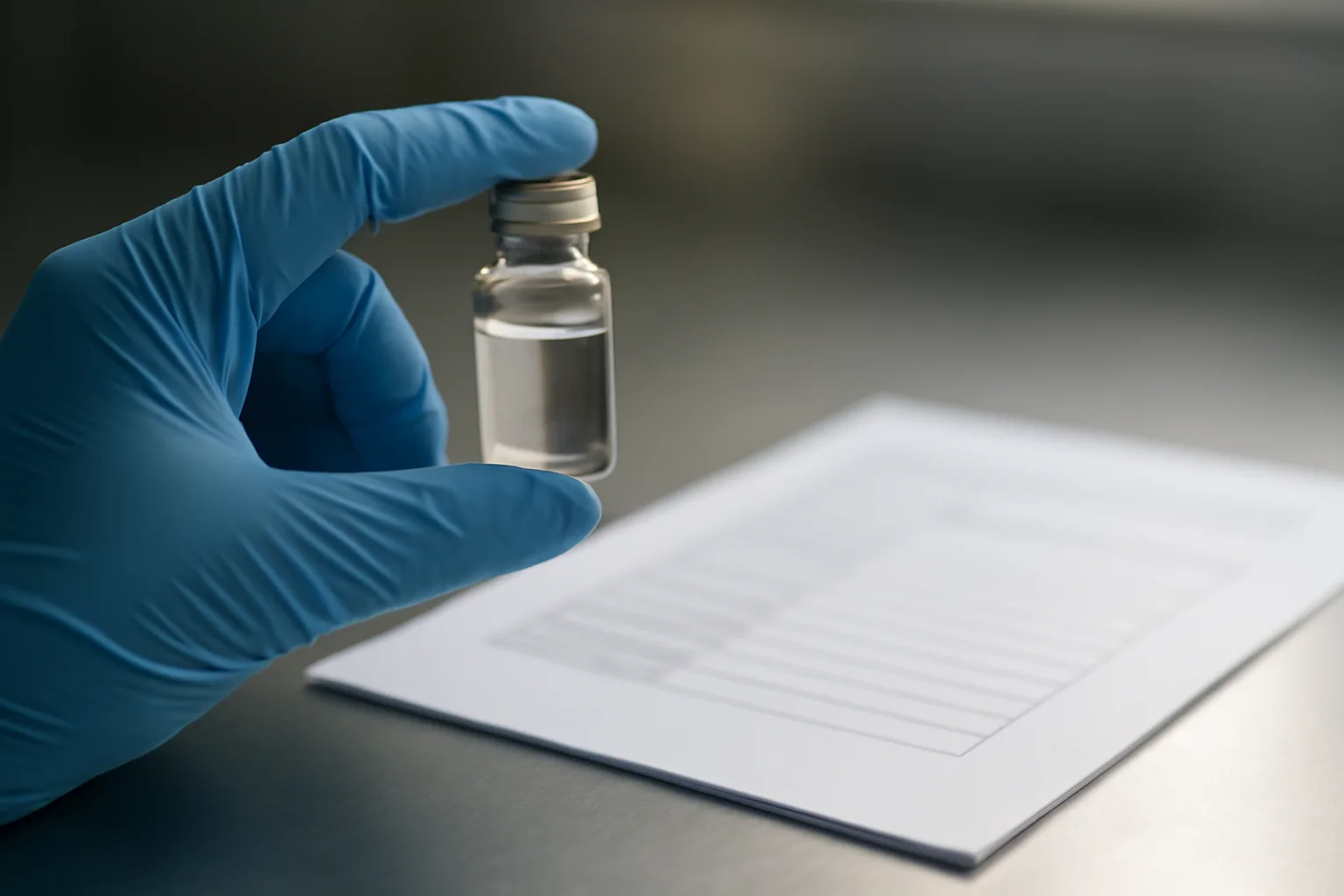
A certificate of analysis (COA) is a lab report that describes what's actually in a vial: how pure the peptide is, whether its identity matches what the label claims, and how much mass is present. It is a chemistry document, not a medical one. Nobody, no lab, no COA, no FDA approval, tells you that a given dose of MOTS-c does anything specific in a human body, because that clinical evidence doesn't exist yet. MOTS-c is not an FDA-approved drug. You can check this yourself in Drugs@FDA, the agency's database of approved drug products [1]. It doesn't show up there because it isn't there. What exists instead is a research literature built almost entirely on mice, rats, and cultured cells: the original 2015 Cell Metabolism paper that put MOTS-c on the map showed the peptide promoted metabolic homeostasis and reduced obesity and insulin resistance in mouse models [2], not in people. So when you're reading a COA for a MOTS-c vial, keep the job of the document narrow. It answers "is this the molecule, and is it clean," not "will this work" or "is this safe for me." Conflating those two questions is the single most common mistake buyers make, and it's exactly the gap a legitimate provider-reviewed route is supposed to close by pairing chemistry documentation with clinical oversight.
What should a legitimate MOTS-c COA actually show?
A useful COA has five components, and if any of them is missing or vague, treat that as a real gap, not a technicality. 1. Identity confirmation, usually by mass spectrometry, showing the molecular weight matches MOTS-c's known sequence. 2. Purity percentage by HPLC (high-performance liquid chromatography), reported as a specific number, not a marketing phrase like "high purity." 3. A batch or lot number that ties the document to the specific vial you're holding, not a generic template reused across every batch a company sells. 4. The testing lab's name and, ideally, its accreditation status, so the report isn't self-graded by the seller. 5. A date, because peptide degrades and a COA from two years ago tells you nothing about the vial in front of you now. None of this tells you about sterility, endotoxin levels, or heavy metal contamination unless those are separately listed as their own line items with their own numbers. A COA that only reports purity and skips everything else is incomplete, even if it looks official.
How do I know if a COA is fake or copy-pasted?
The tell is usually genericness. A copy-pasted COA reads the same across every product page on a site, uses a lot number that never changes, or shows a testing date that predates when the seller says the batch was made. Real HPLC purity traces have a specific look: a chromatogram with one dominant peak and small, labeled side peaks representing impurities, plus a numeric purity value (something like 98.2%, not "98%+"). If the document is just a table with no chromatogram image at all, be more skeptical, not less. Ask whether the seller can produce the raw chromatogram, more than the summary number, if you want to verify. Another check: cross-reference the lab name. Legitimate third-party peptide testing labs are identifiable and, in many cases, have public accreditation. If a COA cites a lab you can't find any record of, or the lab's contact info routes back to the seller itself, that's not third-party testing. That's the seller grading its own homework.
Does a COA prove the product is safe to use?
No. A COA is a chemistry snapshot, not a safety certification, and this is the point where buyers most often get misled by their own hope. MOTS-c research covers a striking range of biology: nuclear gene regulation under metabolic stress [3], skeletal muscle differentiation and CK2 activation [4][5], bone metabolism [6], antiviral activity against HBV in mouse models [7], and even ovarian cancer progression in cell and animal models [8]. That range is genuinely interesting to researchers. It is also, almost entirely, preclinical: mice, rats, cultured cells, not people. A 2026 Sports Medicine review on peptide therapies for musculoskeletal injuries and athletic performance is explicit that the safety and efficacy picture for unapproved peptides used off-label in this space remains poorly characterized [9]. A clean purity number on a COA says nothing about whether injecting that compound is a good idea for you, what dose is reasonable, or what happens with repeated use over months. Purity and safety are different questions, and only one of them has a lab report attached.
Why do MOTS-c sellers even provide a COA if there's no approved use?
Because research-grade peptide sellers operate in a specific regulatory lane, and a COA is how they document that they're staying inside it, at least on paper. Under 21 U.S.C. 353a, pharmacies can compound drugs for individual patients under specific conditions [10], and 21 CFR 216.23 and 216.24 define the "bulks lists" of substances permitted for compounding under sections 503A and 503B of the FD&C Act [11][12]. FDA's own bulk drug substances page for 503A compounding lays out the process substances go through for consideration [13], and the agency maintains a running list of nominated substances [14]. Whether MOTS-c is presently a substance appropriately compounded under this framework is a question a licensed pharmacy or physician, not a seller's product page, should be answering for you. A COA doesn't settle that regulatory question either. It's simply the piece of paper a seller can point to and say "here's what's in the vial." Whether that vial should legally be sold to you, and by whom, is a separate matter entirely, governed by 21 CFR 201.128's definition of intended use [15] and by whether a prescriber is actually involved.
What's the deal with the 'exercise mimetic' claim on MOTS-c labels and COAs?
"Exercise in a pill" is marketing language, not a finding, and it's worth being blunt about that distinction because it shows up constantly in seller copy attached near COAs. The actual research is more specific and more limited. A 2022 Diabetes & Metabolism Journal review covers MOTS-c in the context of mitohormesis, the idea that mild mitochondrial stress (the kind exercise induces) triggers adaptive signaling, and MOTS-c is one molecule implicated in that pathway [16]. A 2021 review in Biochimica et Biophysica Acta specifically examines mitochondrial-derived peptides and exercise as a category [17], and a separate 2021 study found MOTS-c reduces myostatin and muscle atrophy signaling in animal models [18]. A 2025 Scientific Reports paper found MOTS-c mimicked exercise-associated pathways to reduce diabetic liver fibrosis in a mouse model, via the Keap1-Nrf2-Smad2/3 pathway [19]. That's a real and interesting research thread. It is not the same as "this peptide gives you the benefits of a workout," a claim no cited study makes and no COA can verify, because a COA measures chemistry, not physiology. If a seller's marketing next to the COA leans hard on the exercise-mimetic phrase without qualifying it as rodent-model signaling research, treat that as promotional writing, not a summary of the evidence. For dosing questions specifically, see our guide on MOTS-c dosage.
What red flags on a COA should make me walk away?
A few patterns are worth treating as disqualifying, more than "a bit sketchy." No lot number, or a lot number that's identical across multiple product listings on the same site. A purity value with no chromatogram or lab name attached, just a bare percentage. A testing date that doesn't align with any stated manufacture date. A lab address that traces back to the seller's own business address or a residential address. Language on the COA or nearby marketing that promises specific human outcomes ("burns fat," "reverses aging," "boosts your metabolism 20%") since no clinical trial has established a validated human dose-response for any of these claims. Also worth flagging: sellers who won't answer a direct question about which lab ran the test, or who get evasive when you ask for the raw chromatogram rather than the summary table. A confident, specific answer ("tested by [named lab], here's the batch-specific PDF") is a good sign. A vague answer ("it's tested, don't worry") is not.
How does a MOTS-c COA compare to COAs for other research peptides?
The format is largely standardized across the research peptide space; MOTS-c COAs don't look structurally different from COAs for other peptides in terms of what fields they include. The difference is entirely in the underlying evidence base, which is thinner for MOTS-c's specific human claims than the marketing suggests.
| COA element | What it verifies | What it does NOT verify |
|---|---|---|
| HPLC purity % | Chemical purity of the sample | Safety, sterility, or dosing accuracy |
| Mass spec identity | Molecule matches claimed sequence | Biological activity in humans |
| Batch/lot number | Traceability to a specific production run | That the batch you received matches the COA shown online |
| Testing lab name | Third-party (if independent) vs. self-tested | Lab accreditation, unless separately confirmed |
| Test date | Recency of testing | Stability/degradation since that date |
The practical lesson: a MOTS-c COA that looks professional and complete is a reasonable floor for "this seller takes chemistry seriously." It is not evidence that the underlying human-use case is established. For most of the specific disease and injury applications you'll see cited in marketing (osteoarthritis [20], lung injury [21], pulmonary fibrosis [22], asthma [23]), the supporting studies are animal or cell-culture work, not human trials, full stop.
Does a good COA mean the dosing on the label is correct?
No, and this is a distinct failure point from purity. A COA confirms concentration (how much peptide is in the vial, in mg/mL typically), but it says nothing about what dose is appropriate for a person, because no validated human dosing study exists for MOTS-c. Animal studies use body-weight-scaled doses (mg per kg) that don't translate directly to a human dose without pharmacokinetic work that, for MOTS-c, hasn't been published in peer-reviewed human trials as of this writing. A COA reporting "10mg/mL" tells you the concentration is accurate to that number; it doesn't tell you whether 10mg, 5mg, or 1mg is the right amount for anything. For a fuller breakdown of how people are approaching this gap, see MOTS-c dosage and the MOTS-c dosage calculator, and note that neither source can substitute for a clinician's judgment given the absence of human trial data.
Where does the human evidence gap actually sit right now?
It's worth being precise about this instead of hand-waving. As of the current published literature, the great majority of MOTS-c findings, the metabolic ones, the muscle ones, the cardiovascular ones, come from rodent models or in vitro cell work. Examples: the 2015 Cell Metabolism founding paper (mouse) [2], the 2018 Cell Metabolism paper on nuclear translocation under metabolic stress (cell/mouse models) [3], a 2022 Pharmacological Research paper on gestational diabetes relief (rodent model) [24], a 2025 paper on pancreatic islet cell senescence and diabetes (preclinical models) [25], a 2025 Cardiovascular Drugs and Therapy review asking whether MOTS-c is a "magical molecule" for diabetic cardiomyopathy (a title that itself signals early-stage, aspirational framing) [26], and a 2023 Metabolites paper broadly reviewing MOTS-c's role preventing metabolic disorders (again, preclinical) [27]. The 2023 Frontiers in Endocrinology review frames MOTS-c as "a promising mitochondrial-derived peptide for therapeutic exploitation," language that is honest about potential while being explicit that exploitation hasn't happened yet [28]. That's the accurate one-line summary of where the field stands: promising mechanism, thin human data. A COA can't close that gap, and no seller's paperwork should be read as if it does. If you're evaluating the broader evidence picture, our MOTS-c evidence hub walks through the studies in more depth, and how to take MOTS-c peptide and best time of day to take MOTS-c peptide cover practical administration questions separately from the efficacy question.
What should I actually do before buying based on a COA?
Ask for the batch-specific COA, not a generic one pulled from a website template. Confirm the lot number on the document matches the lot number printed on the vial you receive; if there's no lot number on the vial at all, that's a problem regardless of how good the COA looks. Check that the testing lab is named and, if possible, look it up independently rather than trusting the seller's description of it. Ask what HPLC purity percentage is reported, specifically, and treat vague answers as a signal to look elsewhere. Separately, and this is the part that's easy to skip: get clinical input before use. A COA is a chemistry document. Whether MOTS-c makes sense for you, at what dose, with what monitoring, is a medical question that a licensed prescriber should be answering, not a lab report. Provider-reviewed sourcing exists specifically to put that clinical layer on top of the chemistry layer; MOTS-c Co's provider-reviewed listings point toward a fulfilling pharmacy partner precisely so the two questions, is this clean, and should you take it, don't get collapsed into one COA.
Frequently asked questions
What is a MOTS-c certificate of analysis?
It's a lab report showing a specific vial's identity (confirmed by mass spectrometry), purity (by HPLC, as a percentage), and often concentration, tied to a batch or lot number. It's a chemistry document verifying what's in the vial. It does not verify safety, sterility, or that a given dose does anything specific in a human, since no such human trial data currently exists for MOTS-c.
Is MOTS-c FDA approved?
No. MOTS-c does not appear in Drugs@FDA, the agency's database of approved drug products, which you can search directly. It has no approved indication. Its research base is almost entirely rodent and cell-culture studies, including the foundational 2015 Cell Metabolism paper describing metabolic effects in mouse models, not human trials.
What HPLC purity percentage should I look for on a MOTS-c COA?
There's no official regulatory threshold for research peptides sold this way, but a specific numeric value (like 98.5%) with a visible chromatogram is the baseline for a credible COA. A COA that only says "high purity" or "98%+" without a specific figure and supporting chromatogram image is a weaker document and worth questioning.
Can a certificate of analysis be faked?
Yes. Common signs of a fabricated or copy-pasted COA include an identical lot number reused across different batches, no named testing lab, a testing date that predates the claimed manufacture date, or a lab address that traces back to the seller itself rather than an independent facility.
Does MOTS-c actually mimic the effects of exercise?
That's a marketing simplification of a real research thread. Studies link MOTS-c to mitohormesis, the mild-stress adaptive signaling exercise triggers, and to reduced myostatin signaling and muscle atrophy markers in animal models. No study shows MOTS-c replicates the full physiological benefit of a workout in humans; that specific claim isn't supported by the cited literature.
What's the difference between a 503A and 503B bulk drug substance?
Both refer to FD&C Act sections governing pharmacy compounding. 21 CFR 216.23 lists substances approved for 503A compounding (patient-specific pharmacy compounding), while 21 CFR 216.24 covers the 503B list (outsourcing facilities compounding in larger batches). Whether MOTS-c fits either list is a regulatory question a licensed pharmacy should confirm, not something a product-page COA settles.
Does a COA tell me the right MOTS-c dosage?
No. A COA confirms concentration (mg per mL), not an appropriate human dose. No peer-reviewed human dosing trial for MOTS-c currently exists; dosing guidance in circulation is extrapolated from animal studies and isn't clinically validated. See our MOTS-c dosage guide for how people approach this gap, and consult a prescriber before use.
Why do sellers provide a COA if MOTS-c isn't approved for human use?
A COA documents chemistry, which is a separate question from regulatory approval. Sellers operating in the research-compound or compounding-pharmacy space use COAs to show what's actually in a vial. It doesn't resolve whether the product is legally being marketed for human use or whether a prescriber is properly involved in that specific transaction.
Is MOTS-c peptide safe?
Nobody has a full human safety dataset for MOTS-c. A 2026 Sports Medicine review of peptide therapies used off-label for musculoskeletal and performance purposes describes the safety and efficacy evidence for unapproved peptides in this category as still poorly characterized. Most existing MOTS-c safety signal comes from animal studies, not controlled human trials.
What lab tests should be listed on a complete MOTS-c COA?
At minimum: mass spectrometry for identity confirmation, HPLC for purity percentage, and a batch or lot number. A more complete COA also lists sterility testing, endotoxin levels, and heavy metal screening as separate line items. If a COA only shows purity and nothing else, it's incomplete for judging overall vial quality.
Can I verify a MOTS-c COA's testing lab independently?
You should try. Search the lab's name separately from the seller's site, check whether it's an independent facility (not owned by or contracted exclusively to the seller in a way that isn't disclosed), and ask the seller directly whether they can produce the raw chromatogram, more than a summary table, if you want stronger verification.
What does MOTS-c research actually show, if not exercise benefits in humans?
A broad set of preclinical findings: mouse-model metabolic improvements, nuclear gene regulation under stress, skeletal muscle signaling via CK2 activation, bone metabolism effects, antiviral activity against HBV in mice, and roles in conditions from osteoarthritis to lung injury, nearly all in rodent or cell-culture models rather than human trials.
Sources
- FDA, Drugs@FDA database: MOTS-c has no FDA-approved drug product listing
- Cell Metabolism, 2015 (PMID 25738459): MOTS-c promoted metabolic homeostasis and reduced obesity and insulin resistance in mouse models
- Cell Metabolism, 2018 (PMID 29983246): MOTS-c translocates to the nucleus to regulate nuclear gene expression in response to metabolic stress
- iScience, 2024 (PMID 39559755): MOTS-c modulates skeletal muscle function by directly binding and activating CK2
- Peptides, 2022 (PMID 35842023): MOTS-c promotes muscle differentiation in vitro
- Frontiers in Physiology, 2023 (PMID 37200834): MOTS-c has a role in the regulation of bone metabolism
- Gut, 2024 (PMID 37788894): MOTS-c mitochondrial remodeling contributes to an antiviral role during HBV infection
- Advanced Science, 2024 (PMID 39321430): MOTS-c suppresses ovarian cancer progression by attenuating USP7-mediated LARS1 deubiquitination
- Sports Medicine, 2026 (PMID 41966639): Safety and efficacy evidence for unapproved peptide therapies used for musculoskeletal injury and athletic performance remains limited
- 21 U.S.C. 353a, pharmacy compounding: Statute governing conditions under which pharmacies may compound drugs for individual patients
- 21 CFR 216.23, the 503A Bulks List: Defines the list of bulk drug substances permitted for compounding under section 503A
- 21 CFR 216.24, the 503B Bulks List: Defines the list of bulk drug substances permitted for compounding under section 503B
- FDA, bulk drug substances used in compounding under section 503A: Describes FDA's process for evaluating bulk drug substances proposed for 503A compounding
- FDA, bulk drug substances nominated for use in compounding (current list): FDA maintains a running list of substances nominated for compounding consideration
- 21 CFR 201.128, meaning of intended uses: Defines how a product's intended use is determined for regulatory purposes
- Diabetes & Metabolism Journal, 2022 (PMID 35656563): Reviews MOTS-c's role in exercise-linked mitohormesis signaling
- Biochimica et Biophysica Acta, 2021 (PMID 34520826): Reviews the relationship between mitochondrial-derived peptides and exercise
- American Journal of Physiology-Endocrinology and Metabolism, 2021 (PMID 33554779): MOTS-c reduces myostatin and muscle atrophy signaling in studied models
- Scientific Reports, 2025 (PMID 40425777): MOTS-c mimics exercise-linked pathways to reduce diabetic liver fibrosis in a mouse model via Keap1-Nrf2-Smad2/3
- Free Radical Biology & Medicine, 2025 (PMID 41043625): MOTS-c attenuates mitochondrial dysfunction, pyroptosis and cartilage degradation in osteoarthritis models via an Nrf2-dependent mechanism
- Redox Biology, 2025 (PMID 40403491): MOTS-c attenuates lung ischemia-reperfusion injury via MYH9-dependent nuclear translocation
- Mitochondrion, 2023 (PMID 37307934): MOTS-c is studied as a potential anti-pulmonary fibrosis factor
- International Immunopharmacology, 2025 (PMID 40472776): MOTS-c attenuates airway barrier dysfunction in allergic asthma models by inhibiting epithelial apoptosis
- Pharmacological Research, 2022 (PMID 34798268): MOTS-c relieves hyperglycemia and insulin resistance in a gestational diabetes mellitus model
- Experimental & Molecular Medicine, 2025 (PMID 40855115): MOTS-c prevents pancreatic islet cell senescence to delay diabetes onset in preclinical models
- Cardiovascular Drugs and Therapy, 2025 (PMID 40172798): Reviews MOTS-c's potential role in diabetic cardiomyopathy, framed as an open question
- Metabolites, 2023 (PMID 36677050): Reviews evidence that MOTS-c functionally prevents metabolic disorders in studied models
- Frontiers in Endocrinology, 2023 (PMID 36761202): Describes MOTS-c as a promising mitochondrial-derived peptide for therapeutic exploitation