Last updated 2026-07-25
TL;DR
Yes. Once MOTS-c is reconstituted with bacteriostatic or sterile water, it needs refrigeration (roughly 2-8°C / 36-46°F) and is best used within 2-4 weeks. Unreconstituted lyophilized (freeze-dried) powder is more stable and is typically shipped and stored frozen or refrigerated. No published human pharmacokinetic data define an exact shelf life; these ranges come from standard peptide-stability practice, not a MOTS-c-specific stability study.
does MOTS-c need to be refrigerated after mixing?
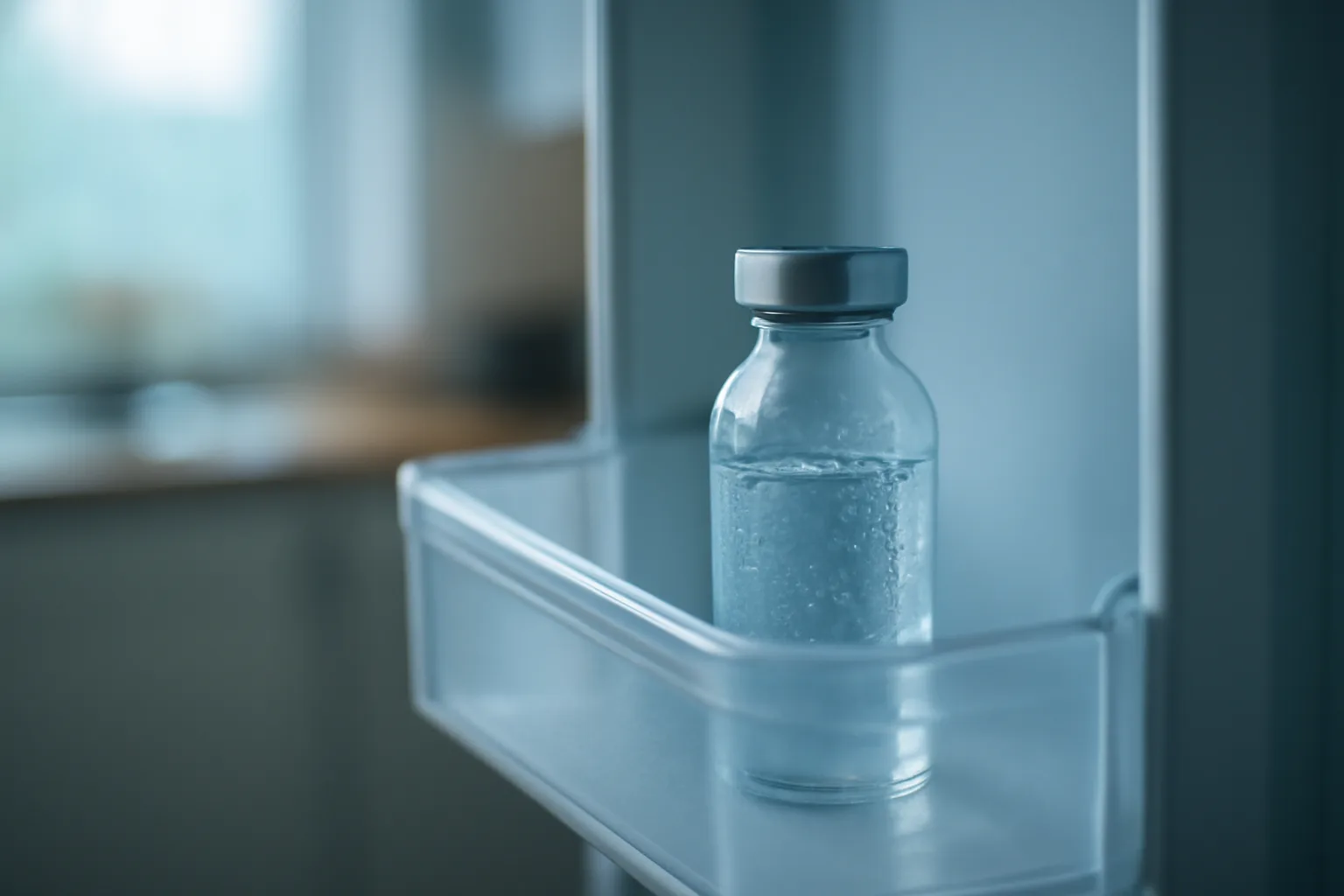
Yes. Once MOTS-c powder is reconstituted with bacteriostatic water or sterile water, it stops being a stable dry peptide and becomes a liquid solution sitting at physiological pH, which is exactly the condition under which peptide bonds hydrolyze and degrade faster. Standard peptide handling practice across the compounding and research-peptide world puts reconstituted vials in a refrigerator at about 2-8°C (36-46°F), not the freezer, and not the counter. There is no published MOTS-c-specific stability study that nails down a precise half-life curve for reconstituted solution at fridge temperature. That's an honest gap. What exists is a body of cell and animal research on what MOTS-c does biologically [1][2], not shelf-life data on the compounded product itself. The refrigeration guidance here is standard practice for small peptides generally, extrapolated to MOTS-c, not a finding from a MOTS-c trial. Practically: keep the vial upright, away from the door (temperature swings when it's opened), and away from direct light. Most compounding pharmacies and research suppliers list a 2-4 week window for reconstituted peptide potency at refrigerator temperature, after which degradation becomes a real concern even if the vial looks and smells normal. Cloudiness, discoloration, or visible particulate is a hard stop; discard it. For a broader read on who's actually asking these storage questions, see MOTS-c in women, where the same handling rules apply regardless of who's using it. Dosing frequency and injection routine also affect how much reconstituted volume you actually need on hand at once, which is worth mapping out before you mix a full vial; see MOTS-c injection sites for how a typical dosing schedule is structured.
how should unreconstituted (lyophilized) MOTS-c be stored?
Lyophilized (freeze-dried) MOTS-c powder is considerably more stable than the reconstituted liquid because there's no water present to drive hydrolysis. Most suppliers ship it either frozen or refrigerated and recommend the buyer keep it that way on arrival: freezer (around -20°C) for long-term storage, or refrigerator if it'll be used within a matter of weeks. The peptide itself, structurally, is a 16-amino-acid mitochondrial-derived microprotein encoded within the 12S rRNA region of mitochondrial DNA [3]. That small size and simple structure make it reasonably stable in dry form compared to larger, more complex proteins, but stable is relative. It is not shelf-stable at room temperature indefinitely, and repeated freeze-thaw cycles on the dry powder (opening the freezer, letting it warm, refreezing) is one of the more common ways people degrade a product before they ever reconstitute it. If you're sourcing from a provider-reviewed pharmacy channel rather than a generic online seller, ask directly how the vial was stored between manufacture and shipment, more than what the label says to do at home. Cold-chain shipping (insulated packaging, ice packs, or dry ice for longer transit) is a reasonable thing to expect and a reasonable thing to ask about before you buy. See how to verify MOTS-c quality for what documentation should actually look like.
what temperature range actually matters?
The commonly cited range for reconstituted peptide storage is 2-8°C, which converts to roughly 36-46°F. That's standard refrigerator temperature, not the vegetable crisper (often colder) and not the door shelf (often warmer and more variable from opening and closing). For comparison, here's how the temperature zones typically get described across peptide handling guidance:
| Storage form | Recommended zone | Typical range |
|---|---|---|
| Lyophilized powder, long-term | Freezer | around -20°C (-4°F) |
| Lyophilized powder, short-term | Refrigerator | 2-8°C (36-46°F) |
| Reconstituted solution | Refrigerator | 2-8°C (36-46°F) |
| Reconstituted solution | Room temperature | not recommended |
These are general peptide-stability conventions, not numbers pulled from a MOTS-c degradation study. Nobody has published a controlled MOTS-c stability trial at each of these temperatures with potency measured over time. If your supplier gives you a specific number that contradicts general peptide practice, ask for their source.
can MOTS-c be frozen once it's been mixed?
Generally not recommended. Freezing a reconstituted solution and then thawing it introduces mechanical stress (ice crystal formation) that can damage peptide structure, and repeated freeze-thaw cycles are worse than a single one. Most guidance for reconstituted peptides, MOTS-c included by extension, says refrigerate, don't freeze, once water has been added. If you've drawn multiple doses into separate syringes ahead of time (a common practice to simplify a dosing routine), refrigerate those pre-loaded syringes rather than freezing them, and use them within the same practical window you'd give the parent vial, generally on the order of two to four weeks. For guidance on where and how doses are actually given, see MOTS-c injection sites.
how long does MOTS-c last once reconstituted?
Most compounding and research-peptide guidance puts usable potency at roughly 2-4 weeks under refrigeration for reconstituted small peptides. Some pharmacy sources are more conservative and suggest closer to 2-3 weeks; others allow up to 30 days. There's no independently published MOTS-c stability curve that settles this with real numbers, so treat any specific day count you're given as an estimate, not a certified expiration. A few things shorten that window in practice: using bacteriostatic water with benzyl alcohol as a preservative generally supports a longer usable period than sterile water without a preservative, because sterile water alone doesn't inhibit microbial growth once the vial is repeatedly punctured. Room-temperature excursions (leaving the vial out overnight, forgetting it in a gym bag) shorten it further, even if the exposure was brief. When in doubt, discard rather than use a vial you can't account for.
does it matter if MOTS-c gets warm during shipping?
Brief warming during shipping, a day or two at ambient temperature in transit, is generally considered lower risk for lyophilized powder than for reconstituted liquid, because the dry form lacks the water needed for most degradation pathways to proceed quickly. That said, prolonged heat exposure (a hot delivery truck, a package left on a porch in summer) is a legitimate concern, and it's one of the more overlooked risks in this category. Most complaints about inconsistent potency in unregulated peptide products trace back to handling, not manufacturing, and there's no way for a buyer to visually confirm a peptide's storage history after the fact. A 2026 review in Sports Medicine on peptide therapies used for musculoskeletal and athletic performance purposes flags handling and quality-control inconsistency as a real-world safety issue across this product category generally, separate from any question about a peptide's biological mechanism [4]. That's a reason to favor suppliers who can document a cold chain, not a reason to assume any given vial is fine because it arrived cool to the touch. If you're comparing suppliers, how to verify MOTS-c quality covers the specific documentation to ask for.
what does MOTS-c actually do, and how much of that is human evidence?
This is where the storage question runs into the bigger one: what are you actually storing carefully for? MOTS-c is a mitochondrial-derived peptide, one of several microproteins encoded in mitochondrial DNA that appear to act as signals between the mitochondria and the rest of the cell, including the nucleus [5][6]. The foundational 2015 paper in Cell Metabolism found that MOTS-c administration in mice improved glucose homeostasis and reduced diet-induced and age-related insulin resistance and obesity [1]. That is a real, specific, and frequently cited finding, and it is entirely a mouse study. Since then, the published body of work has grown into cell and rodent studies across a wide set of tissues and conditions: reduced myostatin and atrophy signaling in muscle [7], suppressed lipid infiltration in disuse-induced muscle atrophy [8], improved glucose control in a rodent model of gestational diabetes [9], and reduced fibrosis markers in a rodent model of diabetic liver disease that the authors explicitly framed as "mimicking exercise" effects [10]. A 2018 Cell Metabolism paper showed MOTS-c translocates to the nucleus under metabolic stress to regulate gene expression there, a mechanistically interesting and unusual finding for a mitochondrial peptide [6]. None of this is human clinical trial data on outcomes like weight, HbA1c, or muscle mass in people. There is also a growing and genuinely diverse mechanistic literature: MOTS-c has been studied in ovarian cancer cell lines [11], and in a range of other preclinical disease models spanning organ systems. That range is a legitimate sign that MOTS-c sits at an interesting biological crossroads. It is also, itself, a tell: most of what's cited as "MOTS-c does X" is one or two rodent or cell-culture papers per condition, not converging human trial evidence.
is the "exercise in a pill" claim for MOTS-c actually supported?
Partly, and only at the level of animal mechanism, not proven human outcome. The phrase gets used a lot in marketing copy, and it originates from a real observation: MOTS-c blood levels rise with acute exercise in some studies, and MOTS-c administration in rodents activates AMPK, a key energy-sensing pathway also activated by exercise, which is why a 2022 review in Diabetes & Metabolism Journal frames MOTS-c within the concept of "mitohormesis," the idea that mild mitochondrial stress (like the stress of exercise) triggers adaptive signaling . A 2021 review specifically on mitochondrial-derived peptides and exercise makes the same connection . But "activates a pathway exercise also activates, in mice" is a mechanistic overlap, not proof that injecting MOTS-c reproduces what a workout does to a human body, cardiovascular conditioning, muscle protein synthesis under mechanical load, bone density changes from impact loading, none of which is a pure biochemical signal you can bottle. A 2023 Diabetes & Metabolism Journal review on MOTS-c, diabetes, and aging-related disease is explicit that this is a peptide of major research interest with mechanisms defined mostly in preclinical models . Nobody has published a human randomized trial showing MOTS-c injections replace or match structured exercise training on hard outcomes. That gap is the honest headline here, not a footnote.
is there any human clinical trial data on MOTS-c at all?
Not in the sense of a completed, published randomized controlled trial measuring clinical outcomes in people. The 2023 Frontiers in Endocrinology review explicitly frames MOTS-c as a peptide "for therapeutic exploitation," language that signals a candidate under investigation, not an approved or clinically validated therapy [5]. Reviews describing MOTS-c's biology similarly discuss preclinical mechanism and potential, using cautious, forward-looking language rather than reporting completed human trial results. This matters for the storage question too: because there's no large-scale clinical manufacturing pipeline for MOTS-c, there's also no FDA-reviewed stability data of the kind you'd find in a Drugs@FDA label for an approved drug . MOTS-c is not on the FDA's 503A bulk drug substances list for compounding . Compounded peptides sourced this way sit in a regulatory gray zone under 21 U.S.C. 353a governing pharmacy compounding , which is part of why storage guidance for MOTS-c is extrapolated from general peptide chemistry rather than backed by a manufacturer's stability-tested label.
how do you know if MOTS-c has gone bad?
Visual and practical checks, since there's no home test for potency. Reconstituted solution should stay clear and colorless (or very faintly off-white, depending on formulation). Cloudiness, visible particles, a change in color, or an off smell all mean discard it, don't use it. Beyond visual cues, track two things: how long it's been since reconstitution, and whether it's had any temperature excursions (left out of the fridge, warmed during a delivery delay, frozen and thawed). A vial that's within its expected window, was stored correctly, and looks normal is reasonably trustworthy. A vial where you can't answer one of those with confidence is a coin flip, and coin-flipping with an unregulated compounded peptide isn't a great trade. If you're unsure whether a specific batch was handled properly before it reached you, that's a sourcing-chain question, not a chemistry question, and it's worth resolving with the pharmacy directly.
what should you actually do, practically?
Buy from a provider-reviewed source that can tell you how the product was shipped and stored, not a random online seller with no documented cold chain. MOTS-c Co reviews providers and points readers toward the pharmacy partner in its network that fulfills orders with documented cold-chain handling, rather than compounding or manufacturing anything itself. Once you have the product: keep lyophilized powder frozen or refrigerated per the label until you're ready to use it. Reconstitute only the amount you'll use within your storage window. Keep reconstituted solution refrigerated at 2-8°C, use it within roughly 2-4 weeks, never freeze it after mixing, and discard anything cloudy, discolored, or of uncertain history. None of this is exotic; it's the same basic discipline used for insulin and other injectable peptides that patients handle at home every day. If you want the biology behind why people are interested in this peptide at all, start with the 2015 Cell Metabolism paper on metabolic homeostasis in mice [1] and the 2018 nuclear translocation paper [6], and read them as what they are: strong, specific preclinical findings, not a settled human story yet.
Frequently asked questions
does MOTS-c peptide need to be refrigerated?
Yes, once reconstituted with water it needs refrigeration at about 2-8°C (36-46°F). Unreconstituted lyophilized powder is more stable and is typically kept frozen or refrigerated per the supplier's label until you're ready to mix it.
how long does reconstituted MOTS-c last in the fridge?
Most peptide-handling guidance suggests roughly 2-4 weeks of usable potency under refrigeration, though there's no published MOTS-c-specific stability study confirming an exact number. Treat any date given by a supplier as an estimate and discard the vial if it looks cloudy or discolored before that.
can you freeze MOTS-c after mixing it with water?
It's not recommended. Freeze-thaw cycles on a reconstituted solution can damage peptide structure through ice crystal formation. Keep reconstituted MOTS-c refrigerated, not frozen, and reserve freezer storage for the unreconstituted lyophilized powder only.
what happens if MOTS-c gets warm during shipping?
Brief warm exposure is a bigger concern for reconstituted liquid than for dry lyophilized powder, since water drives most degradation reactions. Prolonged heat exposure in transit is a real risk factor for reduced potency, which is why documented cold-chain shipping from a reviewed provider matters.
is MOTS-c FDA approved?
No. MOTS-c does not appear in the FDA's Drugs@FDA database of approved drug products, and it is not on the 503A bulk drug substance compounding list, meaning it sits outside the standard regulatory pathway that produces FDA-reviewed stability and safety data.
is MOTS-c actually 'exercise in a pill'?
That's a marketing framing, not a proven finding. Rodent studies show MOTS-c activates AMPK, a pathway exercise also activates, and blood levels rise with acute exercise in some studies, but no published human trial shows MOTS-c injections reproduce exercise's effects on fitness, muscle, or cardiovascular health in people.
what does the 2015 Cell Metabolism MOTS-c study actually show?
It found that administering MOTS-c to mice improved glucose homeostasis and reduced diet-induced obesity and age-related insulin resistance. It's the foundational finding behind most MOTS-c interest, and it is a mouse study, not a human clinical trial.
does MOTS-c help with muscle loss or atrophy?
In rodent and cell studies, yes: MOTS-c has been shown to reduce myostatin and atrophy signaling, promote muscle differentiation in vitro, and suppress lipid infiltration during immobilization-induced muscle atrophy. These are preclinical findings; no published human trial has tested MOTS-c for muscle preservation or growth in people.
how should unopened MOTS-c vials be stored long-term?
Lyophilized (freeze-dried) MOTS-c is generally kept frozen (around -20°C) for long-term storage or refrigerated for shorter-term use before reconstitution, per standard peptide handling practice. Avoid repeated freeze-thaw cycles on the dry powder, and check your specific supplier's label for their stated conditions.
can you tell if a MOTS-c vial has degraded just by looking at it?
Partially. Cloudiness, particulate, discoloration, or an off smell are reliable signs to discard a vial. But a clear, normal-looking solution isn't a guarantee of full potency; there's no home test for peptide degradation, so tracking time-since-reconstitution and temperature history matters as much as visual inspection.
where is MOTS-c actually made in the body, and why does that matter for stability?
MOTS-c is encoded within the mitochondrial 12S rRNA gene region and translated as a small, 16-amino-acid microprotein. Its small size makes the dry (lyophilized) form relatively stable compared to larger proteins, but once dissolved in water, it's subject to the same hydrolysis and temperature sensitivity as other short peptides.
should I buy MOTS-c from any online seller, or does the source matter for storage quality?
Source matters a lot here, because there's no FDA-reviewed manufacturing standard to fall back on. Buying through a provider-reviewed channel that documents cold-chain shipping and handling is the practical way to reduce the risk of receiving a product that was degraded before it even arrived.
Sources
- PubMed, Cell Metabolism 2015 (PMID 25738459): MOTS-c administration in mice promoted metabolic homeostasis and reduced diet-induced obesity and age-related insulin resistance
- PubMed, Metabolites 2023 (PMID 36677050): MOTS-c functionally prevents metabolic disorders in preclinical models
- PubMed, BioEssays 2019 (PMID 31378979): MOTS-c is a mitochondrial-encoded regulator that acts on the nucleus, describing its structural and functional identity as a small microprotein
- PubMed, Sports Medicine 2026 (PMID 41966639): Review of safety and efficacy of approved and unapproved peptide therapies flags quality-control and handling inconsistency across the product category
- PubMed, Frontiers in Endocrinology 2023 (PMID 36761202): MOTS-c is described as a promising mitochondrial-derived peptide for therapeutic exploitation, signaling early-stage research status
- PubMed, Cell Metabolism 2018 (PMID 29983246): MOTS-c translocates to the nucleus to regulate nuclear gene expression in response to metabolic stress
- PubMed, American Journal of Physiology-Endocrinology and Metabolism 2021 (PMID 33554779): MOTS-c reduces myostatin and muscle atrophy signaling in preclinical models
- PubMed, American Journal of Physiology-Endocrinology and Metabolism 2024 (PMID 38170165): MOTS-c attenuates immobilization-induced skeletal muscle atrophy by suppressing lipid infiltration
- PubMed, Pharmacological Research 2022 (PMID 34798268): MOTS-c relieves hyperglycemia and insulin resistance in a rodent model of gestational diabetes mellitus
- PubMed, Scientific Reports 2025 (PMID 40425777): MOTS-c mimics exercise effects to combat diabetic liver fibrosis by targeting the Keap1-Nrf2-Smad2/3 pathway in a rodent model
- PubMed, Advanced Science 2024 (PMID 39321430): MOTS-c suppresses ovarian cancer progression in a preclinical model by attenuating USP7-mediated LARS1 deubiquitination
- PubMed, Diabetes & Metabolism Journal 2022 (PMID 35656563): MOTS-c is discussed within the concept of mitohormesis, linking exercise-induced mitochondrial stress signaling to MOTS-c activity
- PubMed, Biochimica et Biophysica Acta 2021 (PMID 34520826): Review connects mitochondrial-derived peptides including MOTS-c to exercise-induced signaling
- PubMed, Diabetes & Metabolism Journal 2023 (PMID 36824008): Review frames MOTS-c's mechanisms in diabetes and aging-related disease as defined mostly in preclinical models
- FDA, Drugs@FDA approved drug products database: MOTS-c does not appear as an FDA-approved drug product in the Drugs@FDA database
- eCFR, 21 CFR 216.23 (503A Bulks List): MOTS-c is not included on the FDA's 503A bulk drug substances list for compounding
- Cornell Law School Legal Information Institute, 21 U.S.C. 353a: Pharmacy compounding of substances like MOTS-c falls under the federal statute governing compounded drug products, 21 U.S.C. 353a